
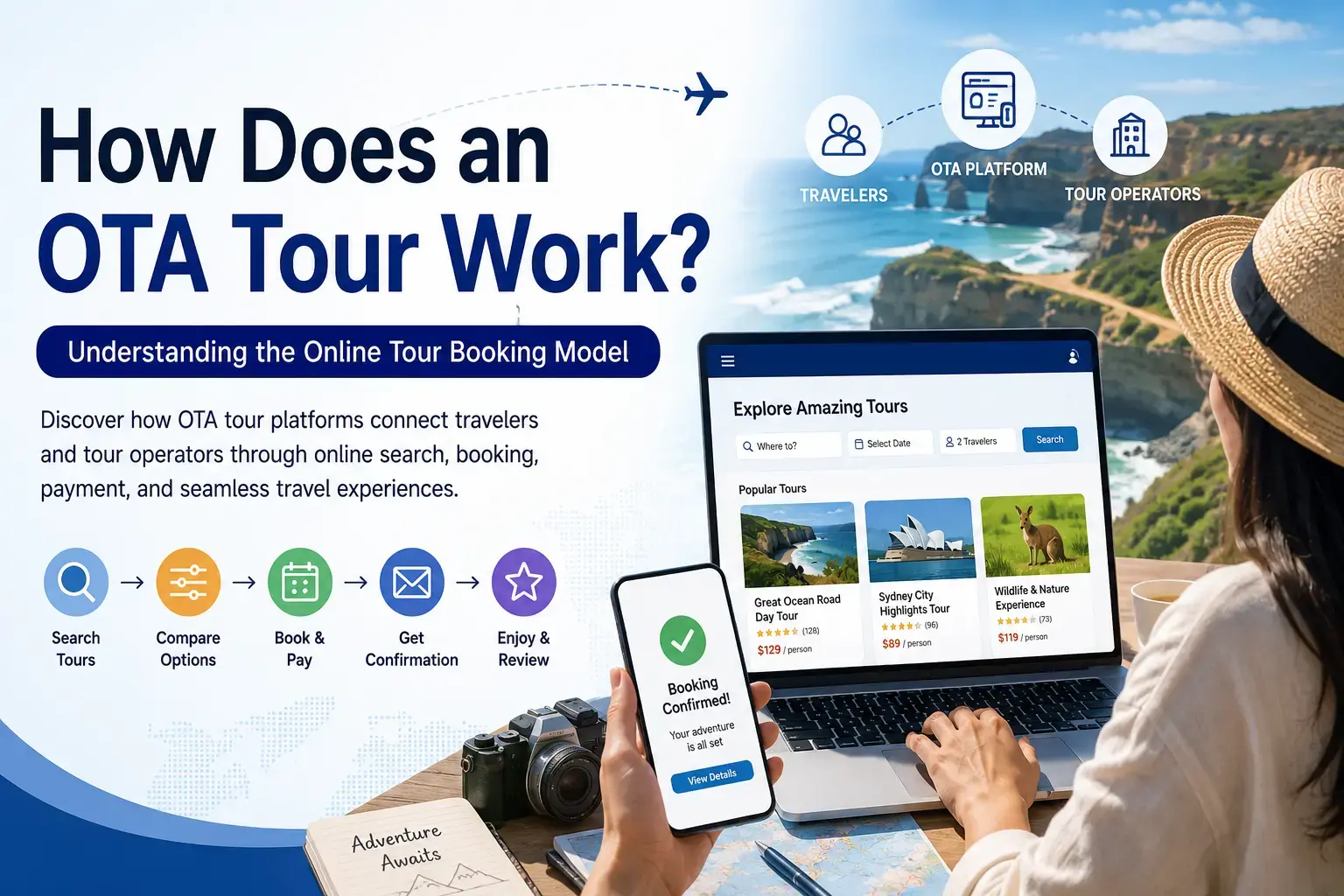
How Does an OTA Tour Work? An OTA tour platform connects travelers with tour operators through an online marketplace, allowing users to search, compare, book, and pay for tours online.
How Does an OTA Tour Work?
The growth of online travel has changed how people discover and book tours. Instead of contacting individual travel agencies or tour operators, travelers can now search for experiences, compare prices, read reviews, check availability, and complete bookings through an online platform.
But How Does an OTA Tour Work?
An OTA tour platform, or Online Travel Agency platform, works as a digital marketplace connecting travelers with tour operators and activity providers. The platform brings tour products together in one online environment and supports different stages of the customer journey, from product discovery to booking confirmation.
The basic process can be summarized as:
Search → Compare → Select → Book → Pay → Confirm → Travel → Review
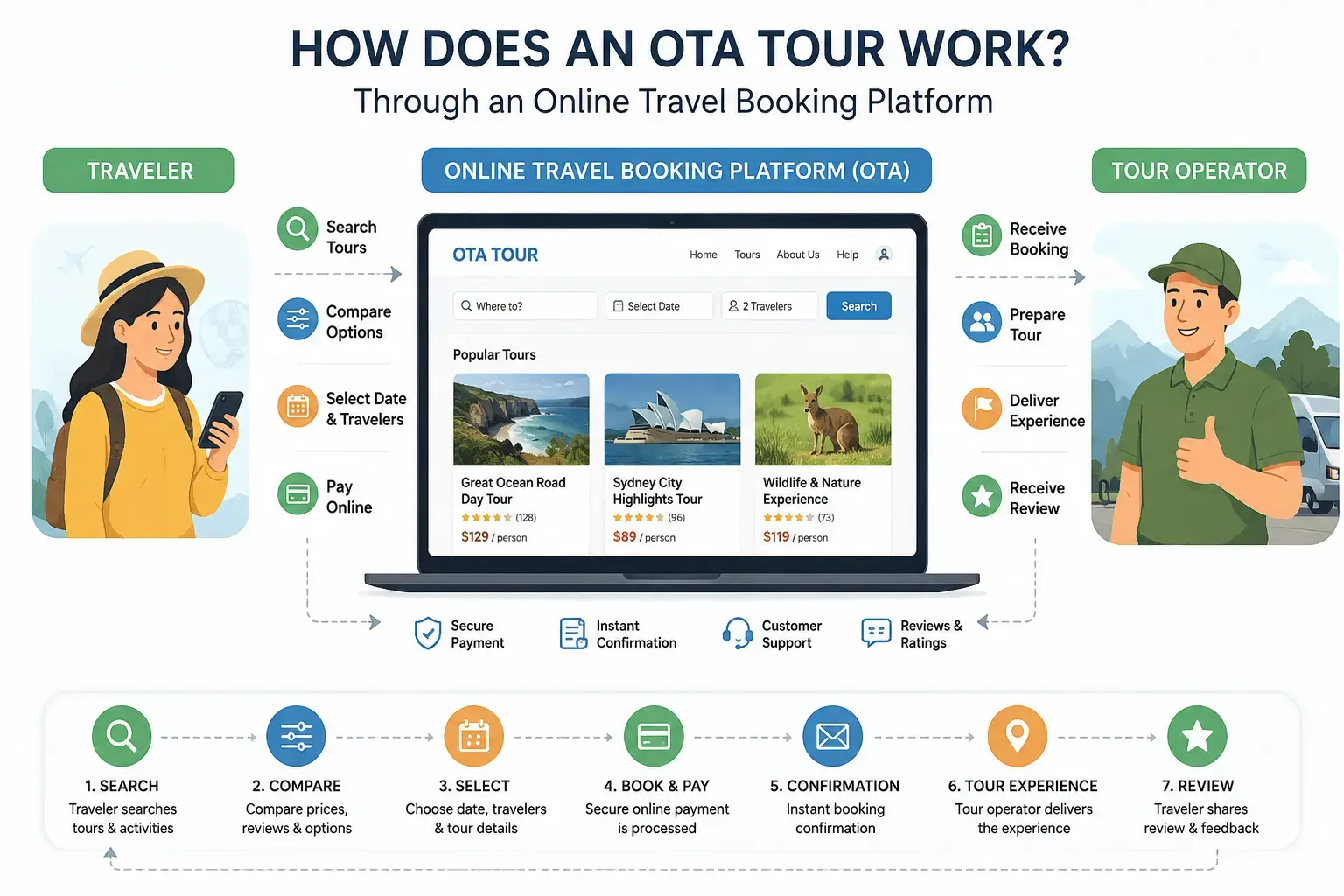
The OTA does not necessarily operate the tour itself. Instead, the tour operator normally provides the actual travel experience while the OTA provides the digital marketplace, technology, distribution, payment infrastructure, and customer-facing booking process.
Understanding How Does an OTA Tour Work? is therefore important for both travelers and tourism businesses.
For travelers, understanding the OTA model explains what happens behind an online booking.
Meanwhile, tour operators can see how OTAs provide an additional distribution channel for reaching potential customers.
For companies planning to build their own OTA tour platform, this understanding is equally important because it helps define the required technology, supplier relationships, revenue model, and customer journey.
What Is an OTA Tour Platform?
An OTA tour platform is an online marketplace where travelers can discover and book tours, activities, attractions, excursions, and other travel experiences.
OTA stands for Online Travel Agency.
Traditional travel agencies generally rely on physical offices, sales teams, phone calls, and personal consultations. An OTA moves much of this process into a digital environment.
A traveler can visit an OTA website or mobile application, search for a destination, select a travel date, compare available products, and complete a booking without visiting a physical office.
This is one of the reasons the question How Does an OTA Tour Work? has become increasingly relevant in modern tourism.
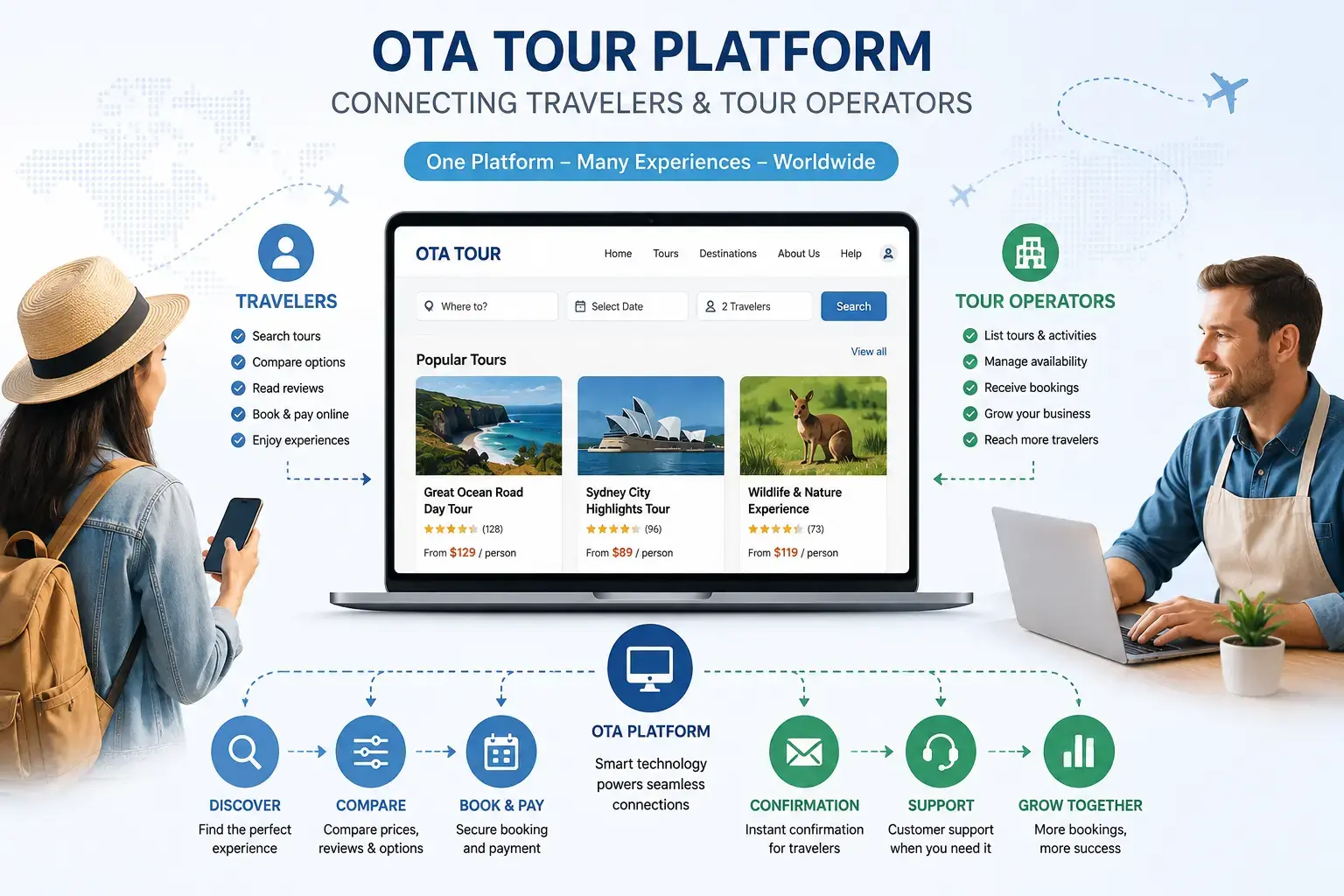
An OTA tour ecosystem generally includes three major participants:
Travelers
Travelers create demand for tours and activities. They search for products, compare options, make bookings, pay online, participate in the experience, and potentially leave reviews afterward.
Tour Operators
Tour operators create and deliver travel experiences. They may provide sightseeing tours, day trips, food tours, adventure activities, transportation, attraction tickets, or multi-day itineraries.
OTA Platforms
The OTA connects the two sides.
The platform displays tour products, manages search and booking functions, facilitates payments, communicates booking information, and may provide customer support.
Therefore, How Does an OTA Tour Work? can be understood as a marketplace relationship where technology connects travel demand with tourism supply.
How Does an OTA Tour Work Step by Step?
To understand How Does an OTA Tour Work?, it is useful to follow the complete booking journey.
Although different platforms use different technologies and business rules, the general process follows several common stages.
Step 1: Travelers Search for a Tour
The customer begins by searching for a destination, activity, attraction, or travel experience.
For example, a traveler visiting Australia may search for:
- Sydney city tours
- Blue Mountains day tours
- Great Ocean Road tours
- Melbourne food tours
- Phillip Island wildlife experiences
- Gold Coast theme park tickets
The OTA processes the search and displays relevant products.
The results may be influenced by factors such as destination, date, availability, price, reviews, product quality, relevance, and platform ranking.
At this stage, the OTA acts as a discovery engine.
The traveler does not necessarily need to know the name of a specific tour operator before starting the search.
Step 2: Travelers Compare Available Products
After searching, travelers can compare different tour products.
Important comparison factors may include:
- Price
- Tour duration
- Departure time
- Meeting point
- Pickup service
- Tour itinerary
- Inclusions
- Exclusions
- Cancellation policy
- Customer reviews
- Tour photos
- Group size
- Available dates
This comparison function is one of the major advantages of an online tour marketplace.
Instead of opening many individual websites, customers can evaluate several options through one platform.
Step 3: Travelers Select a Tour
After comparing available products, the traveler selects a tour.
The customer may then choose a specific date, departure time, number of participants, pickup option, ticket type, or other product variations.
The OTA checks the information required to determine whether the selected option can be booked.
If availability is connected to the operator’s booking system, the information may be exchanged automatically.
Step 4: The Customer Completes the Booking
The traveler enters the required information.
This may include:
- Name
- Email address
- Phone number
- Number of participants
- Travel date
- Pickup location
- Special requirements
The customer then proceeds to the payment stage.
Step 5: Online Payment Is Processed
The OTA provides a digital payment environment.
Depending on the product and platform, customers may pay by credit card, debit card, digital wallet, bank transfer, or another supported payment method.
Once the payment has been successfully processed, the booking can be confirmed.
Step 6: Booking Confirmation Is Issued
The traveler receives booking information.
A confirmation may contain:
- Booking reference
- Tour name
- Date
- Departure time
- Meeting point
- Pickup instructions
- Operator information
- Cancellation policy
- Contact information
This gives the customer a clear record of the reservation.
Step 7: The Tour Operator Delivers the Experience
The tour operator receives the booking information and prepares the required resources.
Depending on the product, this may include:
- Tour guides
- Vehicles
- Attraction tickets
- Equipment
- Meals
- Accommodation
- Transportation
- Activity facilities
The operator then delivers the experience according to the confirmed booking.
Step 8: Customers Leave Reviews
After the tour, the OTA may invite the traveler to submit a review.
Reviews can help future customers evaluate tour quality.
They can also provide operators with feedback about customer expectations and service performance.
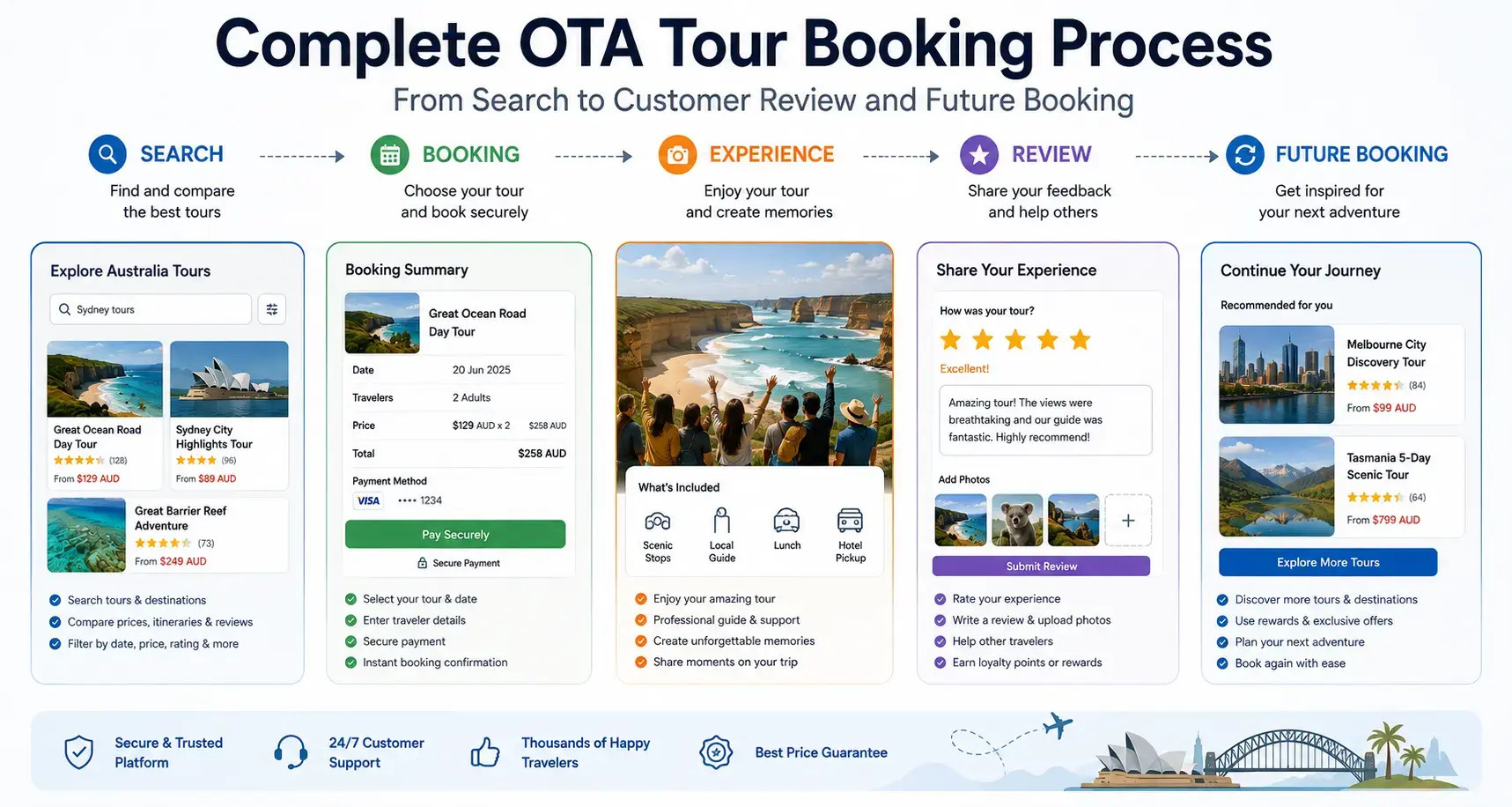
This creates a continuous cycle:
Search → Booking → Experience → Review → Future Booking
How Does an OTA Tour Connect With Tour Operators?
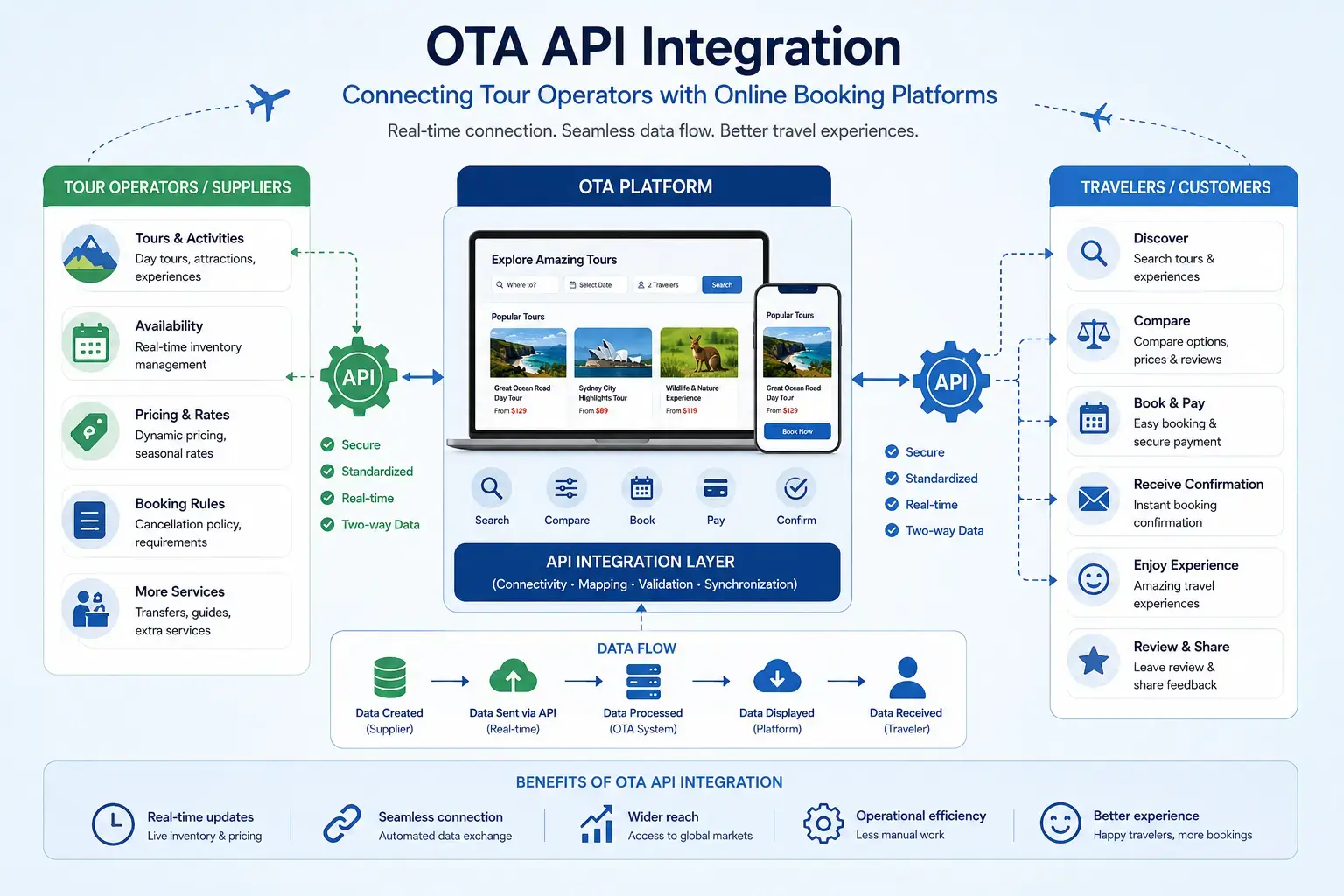
Another important part of understanding How Does an OTA Tour Work? is the relationship between the OTA platform and tour operators.
The OTA needs accurate information about every product listed on its marketplace.
This information can include:
- Product descriptions
- Prices
- Availability
- Operating dates
- Departure times
- Capacity
- Pickup locations
- Inclusions
- Cancellation policies
- Images
- Customer requirements
There are several ways this information can be managed.
Manual Product Management
Small tour operators may manually upload and update their products through a supplier dashboard.
The operator can enter product information and adjust prices or availability when necessary.
This approach is relatively straightforward but requires regular maintenance.
If the operator changes a departure time or availability, the information needs to be updated correctly.
API Integration
Larger tourism businesses may connect their reservation system directly to the OTA through an API.
API stands for Application Programming Interface.
An API allows different software systems to communicate with each other.
For example, when a tour operator has only five seats available, the OTA can receive the available inventory from the operator’s system.
If two customers make bookings, the available inventory can potentially be updated automatically.
This reduces manual work and can help minimize availability errors.
Booking System Integration
An OTA may also connect with third-party reservation systems.
This creates a broader tourism distribution network where tour operators can manage inventory across several sales channels.
This becomes particularly important when one tour is sold through:
- The operator’s website
- An OTA
- Travel agencies
- Hotel partners
- Social media
- Other distribution channels
The more sales channels a tour operator uses, the more important inventory synchronization becomes.
How Does the OTA Tour Commission Model Work?
Revenue is another important part of understanding How Does an OTA Tour Work?
Many OTA tour platforms use a commission-based business model.
The basic principle is simple: the tour operator provides the product, while the OTA generates or facilitates the booking. In return, the platform typically earns a commission based on the agreed commercial terms.
When the booking is completed, the OTA receives an agreed commission according to the commercial arrangement with the supplier.
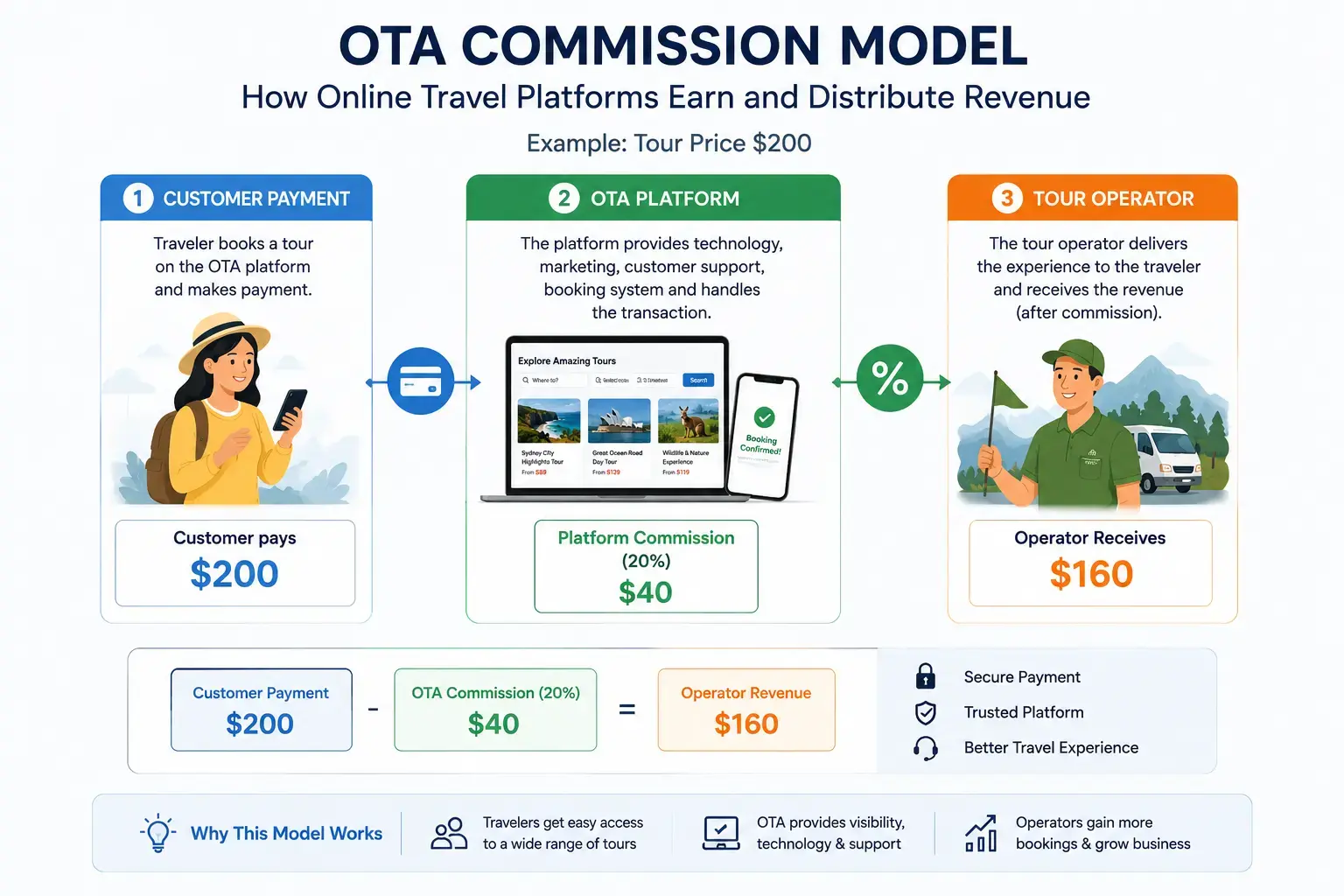
For example, assume a tour sells for $200.
If the agreed commission is 20%, the simplified calculation would be:
Customer booking value: $200
OTA commission: $40
Amount allocated to the operator: $160
This is only an illustrative example.
Actual commission structures can vary depending on the platform, destination, product category, supplier agreement, pricing strategy, and commercial terms.
Why Do Tour Operators Work With OTAs?
A tour operator may accept commission because the OTA provides access to a broader customer acquisition and distribution channel.
Building direct demand can require investment in:
- Search engine optimization
- Paid advertising
- Social media marketing
- Content marketing
- Website development
- Booking technology
- Customer support
- International marketing
- Brand development
An OTA can provide another route to potential customers.
Therefore, the operator needs to evaluate the overall economics rather than looking only at the commission percentage.
The key question is:
Does the additional revenue generated through the OTA justify the distribution cost?
For some businesses, the answer may be yes.
For others, direct booking may provide better economics.
Many established tourism businesses therefore use a combination of direct and OTA distributrevenue
What Happens After an Online Tour Booking?
Understanding How Does an OTA Tour Work? also requires looking beyond the checkout page.
A booking creates an operational process that continues until the tour is completed.
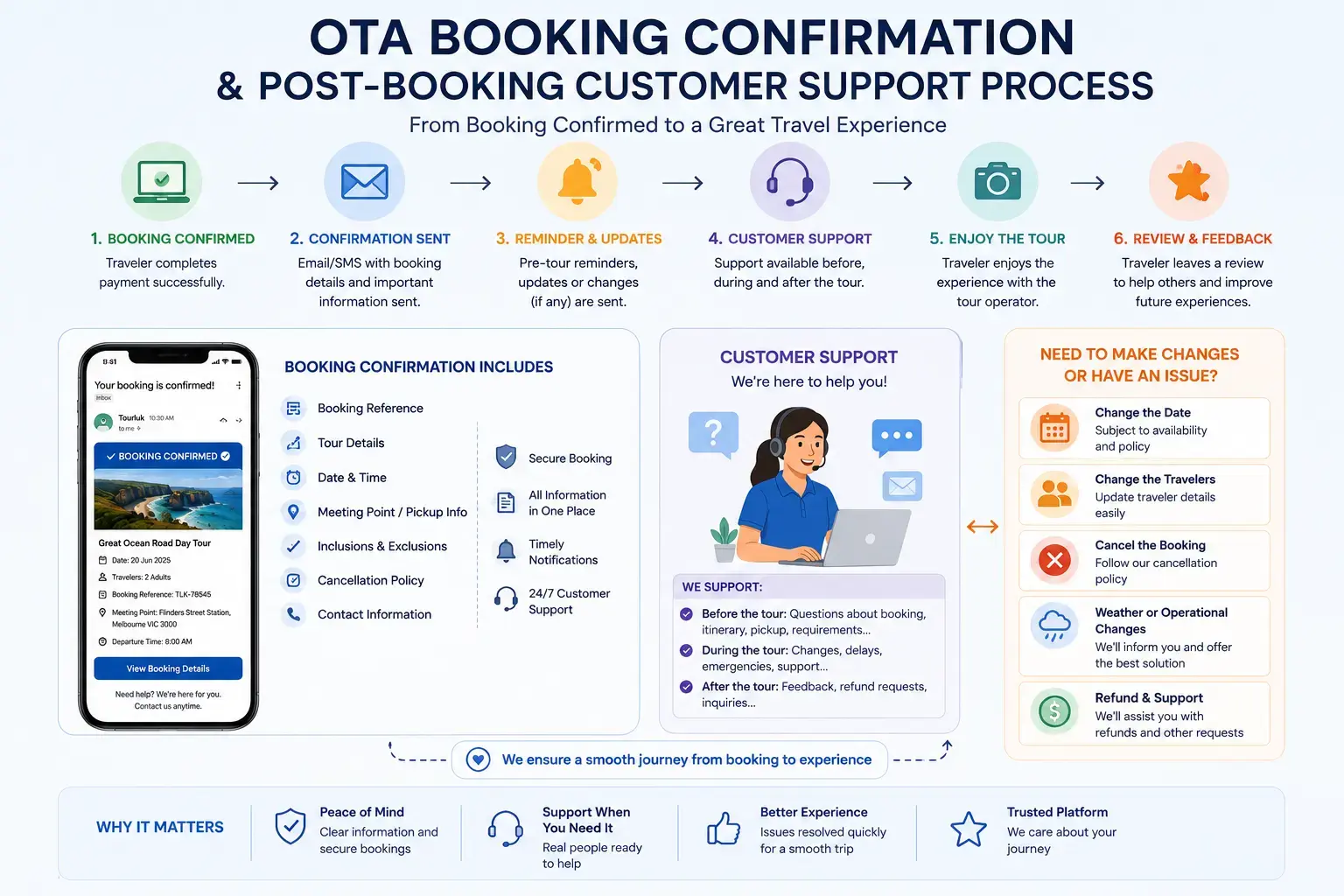
After the reservation is confirmed, the customer may receive an email or mobile notification.
The communication can include important instructions about the tour.
For example, a customer booking a day tour may need to know where to meet the guide and what time to arrive.
Before departure, the OTA or operator may send reminders.
If a booking needs to be changed, the customer may contact the OTA or operator depending on the support structure.
Possible situations include:
- Date changes
- Participant changes
- Pickup changes
- Cancellations
- Refund requests
- Weather-related changes
- Operator schedule changes
- Meeting-point changes
A strong OTA system needs processes for handling these situations.
The customer experience therefore extends beyond the initial payment.
What Are the Benefits of an OTA Tour Platform?
The answer to How Does an OTA Tour Work? becomes clearer when examining the value created for both travelers and operators.
Benefits for Travelers
An OTA tour platform can make travel planning more convenient.
Travelers can search for multiple products through one marketplace.
They can compare different options without contacting every operator individually.
Common benefits include:
- Convenient online search
- Product comparison
- Digital payment
- Booking confirmation
- Customer reviews
- Multiple product choices
- Centralized booking information
- Access to local experiences
This is particularly useful for international travelers.
A visitor arriving in a new country may not know which local operators are reliable or where to find specific activities.
An OTA can provide a structured environment for discovering those experiences.
Benefits for Tour Operators
Tour operators can use OTAs as additional sales and distribution channels.
A small operator may have a strong local product but limited international visibility.
An OTA can help place that product in front of travelers who are actively searching for experiences.
The platform may also provide:
- Online distribution
- Booking technology
- Payment processing
- Customer acquisition
- Product exposure
- Review management
- International reach
However, OTAs also involve costs and platform dependencies.
Tour operators should therefore evaluate their channel strategy carefully.
OTA Tour Booking vs Direct Tour Booking
To fully understand How Does an OTA Tour Work?, it is useful to compare OTA booking with direct booking.
Direct Tour Booking
In a direct booking model, the customer books directly with the tour operator.
The customer may use:
- Company website
- Facebook page
- TikTok
- Zalo
- Phone
- Physical office
The operator generally has greater control over the customer relationship.
It may also have greater control over pricing, communication, branding, and customer data.
However, the operator is responsible for acquiring the customer.
OTA Tour Booking
In an OTA model, the customer discovers the tour through a third-party marketplace.
An OTA creates a digital environment where travelers can discover and book tours. Meanwhile, operators receive bookings through the platform and typically pay an agreed distribution cost or commission. Therefore, OTA and direct booking models offer different advantages depending on the needs of the business.
| Factor | Direct Booking | OTA Booking |
|---|---|---|
| Customer acquisition | Operator | OTA and operator |
| Distribution | Operator-controlled | Platform-based |
| Customer relationship | More direct | Shared |
| Commission | Usually no OTA commission | Usually applicable |
| Technology | Operator responsibility | Partly provided by OTA |
| Product exposure | Depends on operator marketing | Platform marketplace |
| Pricing control | Usually higher | Subject to platform rules |
| Reach | Depends on marketing | Can provide broader distribution |
A strong tourism business may use both channels instead of relying entirely on one.
How to Build an OTA Tour Booking Platform
Companies interested in creating an OTA need to understand that an OTA tour platform is more than a website containing tour listings.
The platform needs technology, suppliers, customers, payment systems, operational processes, and marketing.
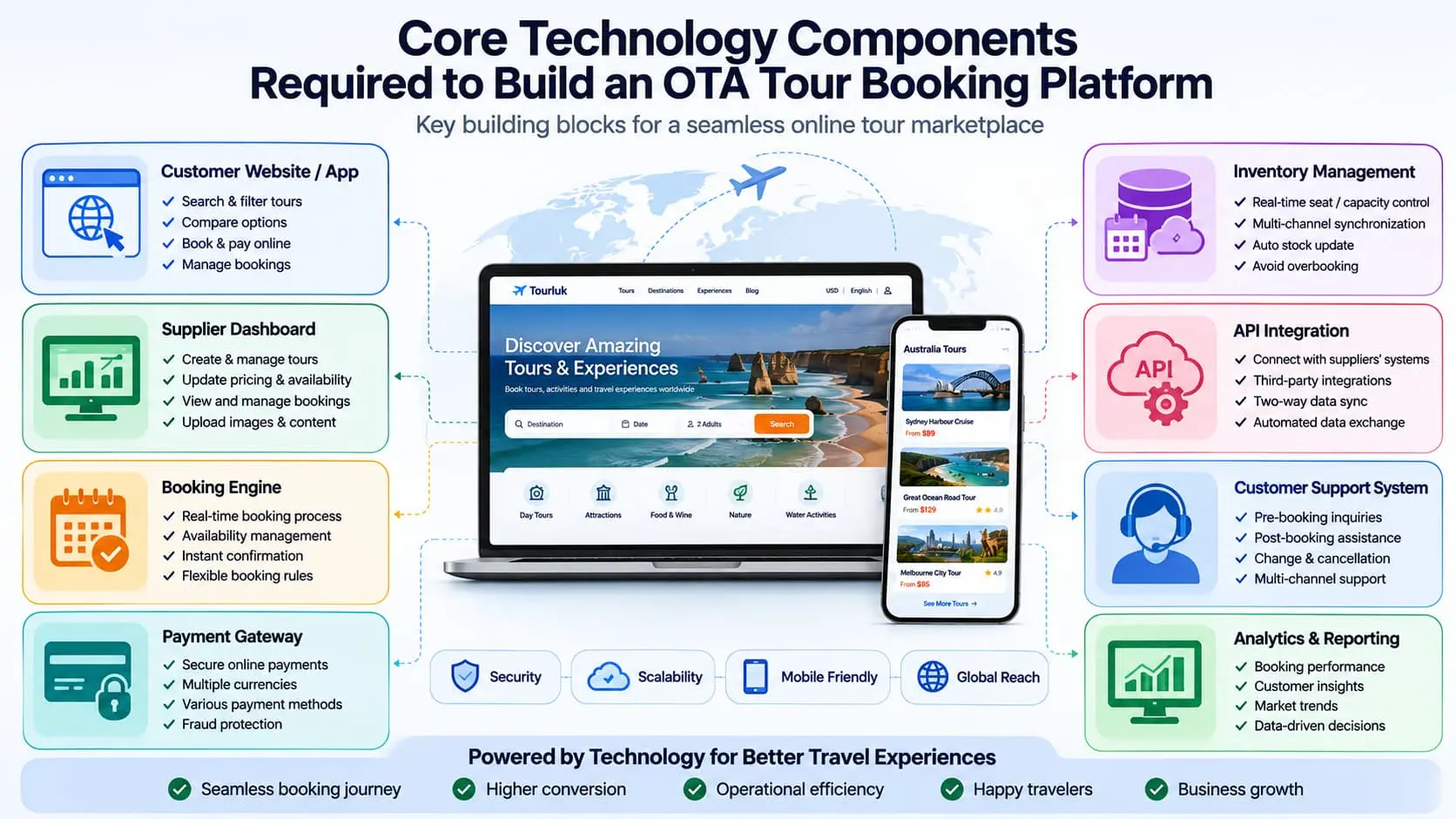
Customer-Facing Website
The website should allow travelers to:
- Search tours
- Filter results
- Compare products
- View tour details
- Check availability
- Make bookings
- Pay online
- Receive confirmation
- Manage reservations
The customer experience should be simple because every unnecessary step can create friction.
Supplier Dashboard
Tour operators need tools to manage their products.
A supplier dashboard can allow operators to:
- Create tours
- Update prices
- Manage availability
- Upload images
- Add schedules
- Manage bookings
- Review customer information
- Update policies
Booking Engine
The booking engine is one of the core components of an OTA.
It processes reservations and connects customer actions with supplier operations.
Payment System
The platform needs secure payment processing.
The payment system should support the currencies and payment methods relevant to the target market.
Inventory Management
Inventory management becomes important when tours have limited capacity.
For example, a minibus tour may have 20 seats.
The platform needs to know how many seats remain available.
API Connectivity
API connectivity can connect the OTA with supplier systems.
This can reduce manual work and improve synchronization.
Customer Support
Travelers may need help before, during, or after a booking.
Therefore, customer support is an important part of the OTA business model.
Technology can automate many processes, but human support may still be necessary for complex situations.
How Does an OTA Tour Create Value?
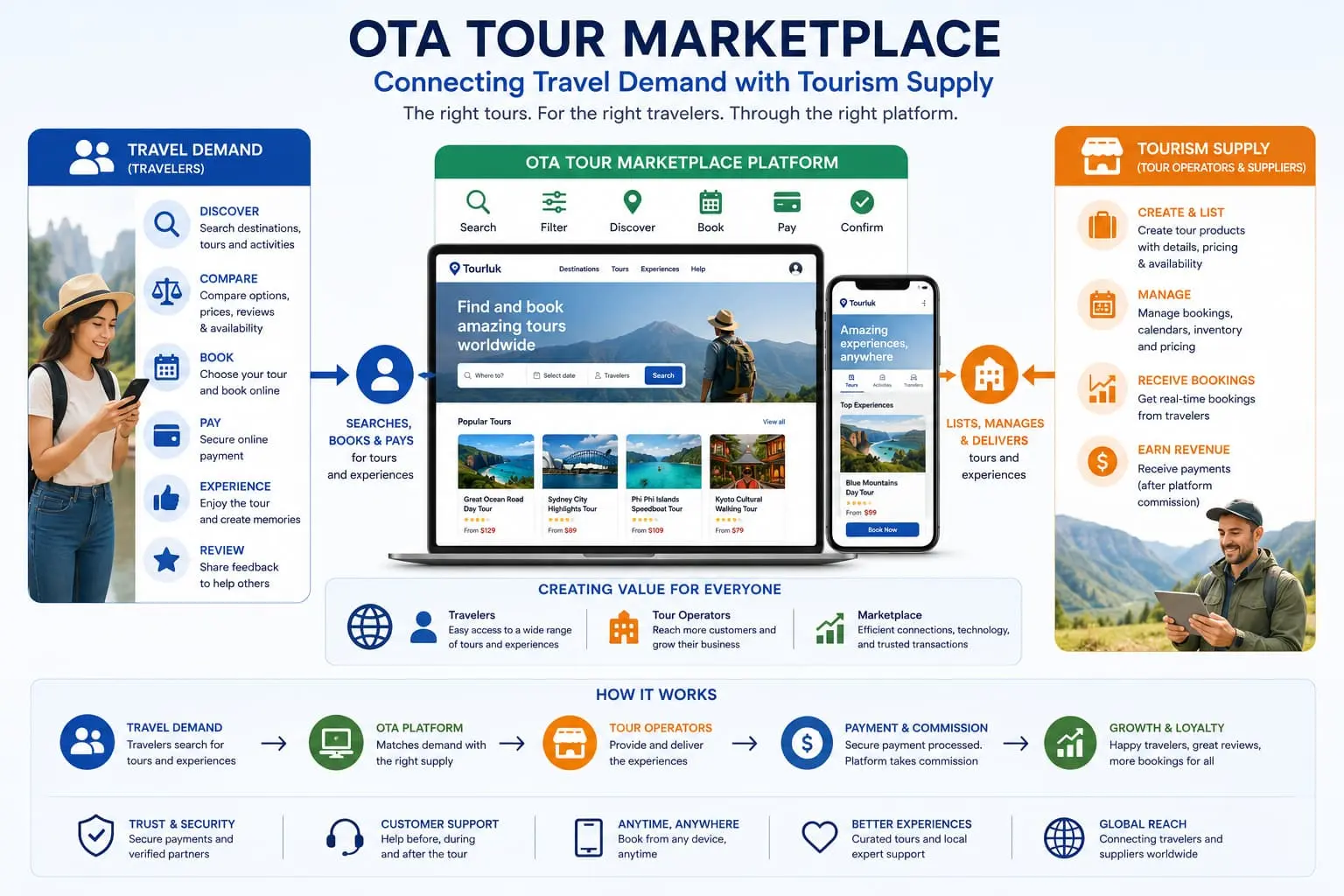
At the most basic level, How Does an OTA Tour Work? can be explained through the relationship between supply and demand.
Travelers create demand.
Tour operators provide supply.
The OTA creates a digital marketplace connecting the two.
The platform reduces friction in several areas.
Travelers do not have to search through dozens of websites.
Operators do not necessarily need to acquire every customer independently.
The OTA provides a centralized environment where products can be discovered and purchased.
This creates value through:
Discovery + Comparison + Technology + Distribution + Booking + Payment + Support
An OTA is therefore more than an online catalog.
It combines marketplace functionality with travel distribution and booking technology.
For tourism companies, this distinction is important. Understanding how OTA platforms operate can also help businesses evaluate different online distribution models and identify suitable partners. To learn more about Tourluk and its approach to online tour distribution, visit the About Tourluk page.
A business planning an OTA platform should not focus only on building a website.
It also needs to consider supplier acquisition, customer acquisition, pricing, inventory, payment processing, customer service, marketing, technology, and operational scalability.
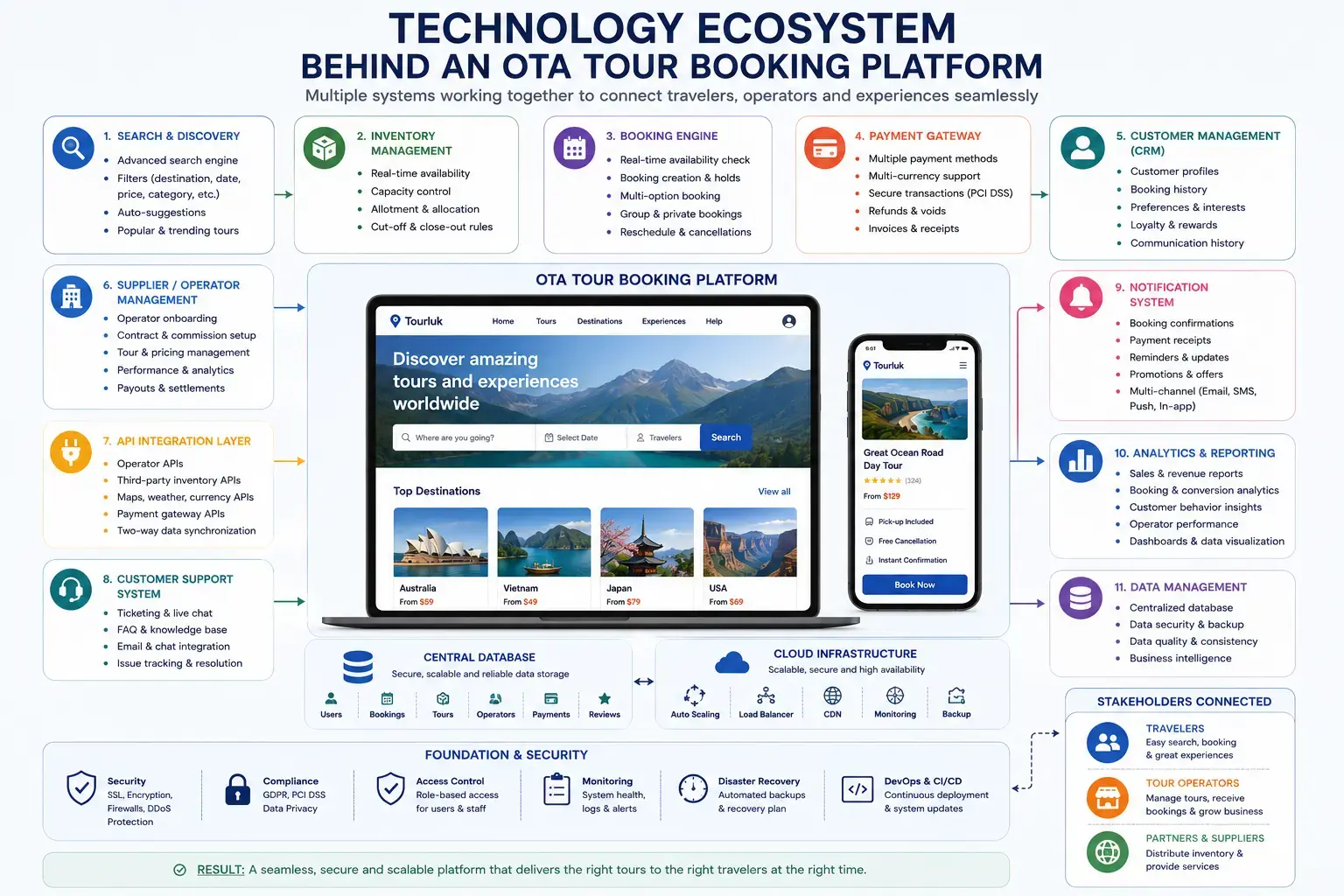
The Role of Technology in the OTA Tour Model
Technology plays a central role in answering How Does an OTA Tour Work?
Modern OTA platforms rely on multiple systems working together.
These can include:
- Search technology
- Booking engines
- Payment gateways
- Customer databases
- Supplier dashboards
- Inventory systems
- APIs
- Analytics platforms
- Review systems
- Customer support tools
- Marketing automation
Data is particularly important.
The platform needs accurate information about tour prices, schedules, availability, customer bookings, and product performance.
Analytics can help the OTA understand:
- Which tours receive the most views
- Which products convert best
- Which destinations attract demand
- Which marketing channels generate bookings
- Which products receive strong reviews
- Where customers abandon the booking process
This information can then be used to improve the customer experience and commercial performance.
Why Do Travelers Use OTA Tour Platforms?
Travelers increasingly expect digital convenience when planning trips.
They want to research activities before arriving at their destination.
For example, travelers can explore different destinations and activities through platforms such as Tourluk, where they can discover and book tours and travel experiences online.
The value is particularly clear when travelers visit unfamiliar destinations.
For example, someone traveling to Melbourne may not know which local operator provides a suitable Great Ocean Road experience.
Instead of searching dozens of websites, the traveler can search an OTA marketplace and compare available options.
Reviews also reduce uncertainty.
Travelers can evaluate previous customer experiences before making a purchase.
The combination of search, comparison, reviews, booking, and payment creates a more structured buying journey.
This is one of the key reasons the OTA model continues to play an important role in tourism distribution.
Frequently Asked Questions About OTA Tour Booking
- What Does OTA Mean in Tourism?
OTA means Online Travel Agency. An OTA is a digital platform that connects travelers with travel suppliers and allows customers to search, compare, and book travel products online. - How Does an OTA Tour Work?
An OTA tour works by connecting travelers with tour operators through an online marketplace. The traveler searches for a tour, compares products, selects an option, checks availability, completes payment, receives confirmation, and participates in the tour. - How Does an OTA Tour Make Money?
Many OTA platforms generate revenue through commissions on successful bookings. Other revenue models can include advertising, promoted listings, service fees, subscriptions, partnerships, or supplier services. - Is an OTA a Tour Operator?
Not necessarily. An OTA primarily provides a digital marketplace and booking channel. The tour operator is generally responsible for delivering the actual travel experience. - Can Tour Operators Sell Through Multiple OTAs?
Yes. Tour operators can distribute products through multiple OTA platforms as well as their own direct channels. However, they need effective inventory management to reduce the risk of conflicting availability. - What Is an OTA Commission?
An OTA commission is the amount or percentage paid to the OTA for generating or facilitating a booking.The exact commission structure depends on the commercial agreement between the OTA and the tour operator. - What Technology Does an OTA Use?
An OTA can use booking engines, APIs, payment gateways, inventory management systems, supplier dashboards, customer databases, analytics, and customer support technology. - Is OTA Booking Better Than Direct Booking?
Neither model is automatically better for every business.OTA booking can provide distribution and customer acquisition, while direct booking can provide greater control over the customer relationship and potentially lower distribution costs.Many tourism businesses use both.
Conclusion: How Does an OTA Tour Work?
Understanding how an OTA tour works helps travelers and tourism businesses see how online tour booking has evolved. OTA platforms connect travelers with tour operators through digital search, product comparison, online booking, payment, and customer reviews.
For travelers, choosing the right platform can make it easier to discover and compare tours, activities, and local experiences. Different OTA platforms may offer different destinations, product selections, booking features, and customer experiences.
If you want to explore the differences between some of the major platforms, read our detailed comparison of Klook vs Viator vs GetYourGuide: Comparing 3 Tour Booking Platforms. This guide provides a closer look at how these platforms differ and what travelers should consider when choosing an OTA for their next trip.
For tour operators, understanding the OTA model can also help when deciding between direct bookings and third-party distribution channels. A balanced strategy can combine an operator’s own website with selected OTA platforms to reach different customer segments.
Ultimately, an OTA tour platform is more than a website for booking activities. It is a digital marketplace that connects travel demand with tourism supply while supporting discovery, comparison, booking, payment, and post-booking services.
Learn more about Tourluk:
Tourluk and Star Group’s Partnership with Tourism Australia’s KDP.